
Responsible Waste Management
Responsible material stewardship and efficient waste management are integral to our sustainability strategy and operational excellence. Our approach to waste management is grounded in the principles of sustainable consumption, resource conservation, and circularity. By prioritising reduction, recovery, and recycling across the value chain, we aim not only to lower our environmental footprint but also to achieve measurable cost savings, improve operational productivity, and instil pride among our workforce.
Our Approach to Waste and Material Stewardship
We follow a lifecycle-based approach to waste management, minimising the use of natural resources and toxic materials while reducing waste generation at the source.
Driving Circularity Through the 5R Framework
Our “Zero Waste to Landfill” initiative for waste empowers us to continually embed the 5R philosophy – Reduce, Reuse, Recycle, Recover, and Reprocess – across all APSEZ facilities. This approach enables efficient resource recovery and boosts circularity within our operations.
Key highlights:
Our waste management measures contribute directly to our long-term goal of achieving zero waste across the organisation while fostering a circular economy mindset.
Performance in FY 2025-26
We monitor progress on waste management using Key Performance Indicators (KPIs) such as:
- Total waste generated (hazardous and non-hazardous)
- Share of waste managed under 5R principles
- Waste recycled, reused, reprocessed, or recovered
- Quantum of waste disposed through landfill or incineration
- Waste intensity (MT/Crore revenue)
In FY 2025-26
99% of all waste was processed under the 5R principles. Of the total waste handled,
A total of 6,888 MT of metal scrap was sold for recycling, supporting circular economy initiatives, and enabling secondary raw material markets. All our sites have successfully eliminated single-use plastics.
Execution against targets (FY 2025-26)
| Indicator | Target | Status |
|---|---|---|
| Zero waste to landfill | 12 ports | 12 ports |
Waste processing breakdown (MT)
| FY 2021-22 | FY 2022-23 | FY 2023-24 | FY 2024-25 | FY 2025-26 | |
|---|---|---|---|---|---|
| Waste recycled/reused (MT)* | 10,468 | 11,108 | 10,390 | 9,657 | 13,817 |
| Total waste disposed (MT) | 2,527 | 2,216 | 2,191 | 2,688 | 919 |
| Waste landfilled (MT) | 1,694 | 944 | 893 | 2,088 | 169 |
| Waste incinerated with energy recovery (MT) | 710 | 1,132 | 953 | 508 | 359 |
| Waste incinerated without energy recovery (MT) | 123 | 140 | 345 | 92 | 391 |
| Waste otherwise disposed (MT) | 0 | 0 | 0 | 0 | 0 |
*includes recovered and repurposed method too
Waste Intensity (MT/Crore)
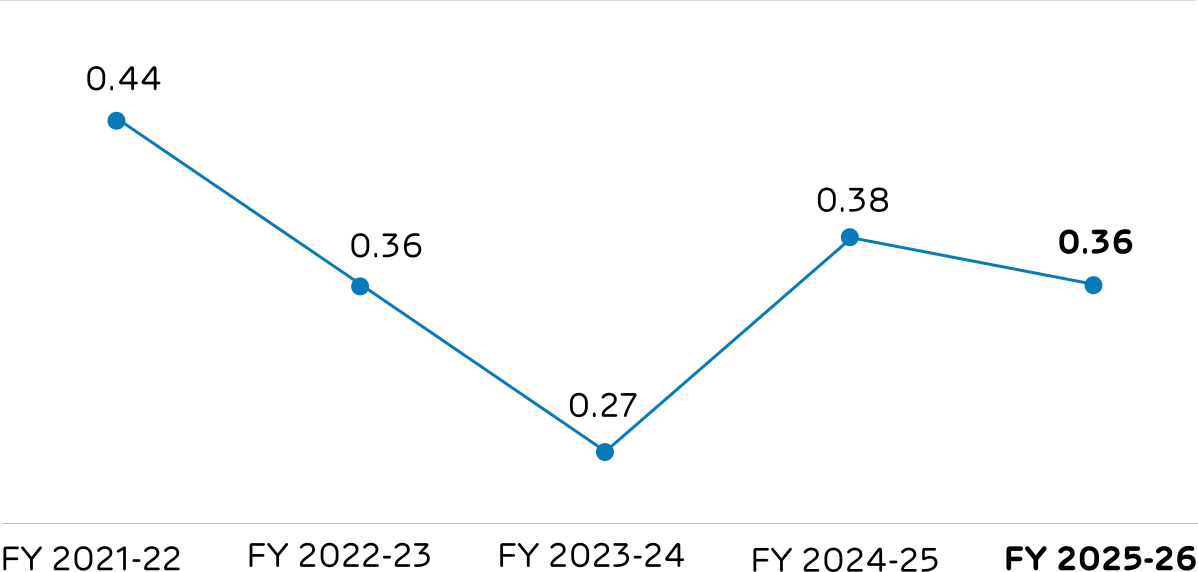
We remain committed to achieving a 20% reduction in waste intensity by 2030, from the baseline.
FY 2025-26 Waste Disposal Summary
APSEZ disposed:
Additionally, 6,888 MT of metal scrap was redirected for recycling.
Waste by Category
| FY 2022-23 | FY 2023-24 | FY 2024-25 | FY 2025-26 | |
|---|---|---|---|---|
| Bio-Medical Waste (MT) | 10 | 125 | 15 | 10 |
| Battery Waste (MT) | 13 | 56 | 37 | 166 |
| E-Waste (MT) | 111 | 82 | 58 | 51 |
| Hazardous Waste (MT) | 1,324 | 2,307 | 5,975 | 6,432 |
| Non-Hazardous Waste (MT) | 13,792 | 10,073 | 5,777 | 7,152 |
| Construction & Demolition Waste (MT) | 0 | 0 | 165 | 235 |
| Plastic Waste (MT) | 894 | 591 | 318 | 313 |