
Nurturing culture of ethical and responsible governance

The governance strategy and framework at APSEZ is rooted in an organisation-wide culture of ethics and responsibility. Transparency and integrity are central to our governance approach, which drives our efforts to boost India’s sustainable social and economic progress. The key elements of this strategy encompass effective risk management, stringent compliance to norms and procedures, and a strong commitment to promoting stakeholder concerns and interests. Ethical business conduct, coupled with our dedication to ensuring workplace safety and environmental consciousness, is embedded in this strategy, which further aids the company in delivering sustained shareholder value. As a responsible corporate citizen, we have built our corporate governance framework around the tenets of integrity, fairness, accountability, and transparency. We are committed to strict compliance with these values for the protection of stakeholder interests.
Key Highlights
Capitals Impacted
 Financial
Capital
Financial
Capital Intellectual
Capital
Intellectual
Capital Social & Relationship Capital
 Human Capital
 Natural
Capital
Natural
CapitalMaterial Topics
SDG Alignment




GRI Linkage:
GRI 2-9, 10, 11, 12, 13, 14, 15, 16, 17, 18, 19, 20, 21, 24, GRI 205, GRI 206, GRI 405, GRI 415 & GRI 418

At Adani, governance underpins long-term value creation. As we scale, amid heightened stakeholder expectations, we remain committed to integrity, transparency, and accountability.
Our Corporate Governance Philosophy
Courage
We shall embrace new ideas and businesses
Trust
We shall believe in our employees and other stakeholders
Commitment
We shall stand by our promises and adhere to a high standard of business
APSEZ Governance Structure
The corporate governance structure and standards at APSEZ are benchmarked to the best global practices, with our Board of Directors responsible for governance framework. The Board guides the company’s identity and strategic direction, while upholding the integrity and accountability of our governance practices.
We have strategically aligned our governance framework towards a structured strategy, designed to set goals, monitor performance, and effectively manage risks. The Board is entrusted with the task of driving the policies, values, mission, vision, overall strategies, objectives and performance targets at APSEZ.
We have established several expert committees to aid the Board in the execution of its responsibilities. Each of the committees is entrusted with handling a specific governance aspect, ensuring exhaustive oversight and effective management while facilitating the company in maintaining high standards of corporate governance. The entire framework is focussed on driving transparency, accountability and sustainable growth for the benefit of all stakeholders.
Audit Committee
Upholds the integrity of financial statements, and compliance with legal and regulatory requirements and internal controls.
Nomination and Remuneration Committee
Oversees Board and executive appointments and their compensation, promoting leadership and fairness.
Stakeholders' Relationship Committee
Manages and fosters relationships with various stakeholders, enabling quick and effective response to their concerns.
Corporate Responsibility Committee
Drives sustainable practices, as well as ESG targets and goals.
Corporate Social Responsibility Committee
Maintains ethical business practices and community engagement initiatives, emphasising our commitment to social responsibility.
Information Technology & Data Security Committee
Protects digital assets, ensuring the security and integrity of data and IT systems.
Risk Management Committee
Identifies, assesses and mitigates risks, ensuring robust risk management practices.
Mergers & Acquisitions Committee
Guides strategic mergers, acquisitions and partnerships, promoting growth and expansion.
Legal, Regulatory & Tax Committee
Manages legal, regulatory and tax affairs, ensuring compliance and mitigating legal risks.
Reputation Risk Committee
Protects and strengthens the company's reputation, addressing the risks likely to impact stakeholders' perception.
Board Composition and Structure
A balanced mix of Executive, Non-Executive and Independent Directors defines the Board’s structure at APSEZ. The Board composition is aligned with regulatory standards, in line with the Securities and Exchange Board of India (SEBI) Listing Obligations and Disclosure Requirements and the Companies Act, 2013. This compliance enables the company to ensure effective corporate governance. Every member of the Board comes with a distinct set of skills, knowledge, experience, and diversity.
The roles of the Chief Executive Officer (CEO) and the Chairperson are clearly separate to uphold principles of good corporate governance. This separation ensures a balanced distribution of authority, prevents concentration of power, and promotes independent oversight of management. The Chairperson, as a founding member of the organisation, serves in a non-executive capacity, providing strategic guidance while maintaining objectivity and independence with respect to day-to-day operations.
2
No. of Executive Directors
5
No. of Independent Directors
3
No. of Non-executive Directors
10
Total Board Size
Board Type
One Tier System
Target share of independent directors
50%
Board Diversity (% of women in BOD)
10%
Average tenure of Board members in years
8
9
No. of Board Meetings
1
No. of Independent Directors’ Meetings
25%
of Minimum Attendance for All Members
33
No. of Committee Meetings
86.67%
Average Board Meeting Attendance
4
No. of Non-executive, Independent Directors with 4 or less other mandates
7(as per SEBI)
No. of other mandates for Non-executive, Independent Directors restricted
14.26 lakhs
Median annual compensation of all employees
218.2:1
CEO to Employee pay ratio
Board Accountability
The Board’s accountability is a key facet of our governance structure and we remain committed to upholding the same. The average meeting attendance of our Board consistently exceeds 75%, underlining the active participation of all Board members in the governance process. Any changes or amendments to the Memorandum of Association and Article of Associations (MoA and AoA) require a mandatory shareholder approval, ensuring that the shareholders’ interests are protected in any major governance decision.
We protect our Directors against personal financial liability for claims triggered by decisions made in their professional capacity. This is ensured by maintaining Directors & Officers (D&O) insurance, subject to such actions being lawful and in good faith.
Board Performance Assessment & Familiarisation
Our well-defined annual assessment and familiarisation programmes together ensure that the Board's functions are both reflective as well as forward-looking. This enables us to move consistently ahead on the path of excellence in governance and business leadership.
Board Performance Reviews
- Internal Assessment Process: The APSEZ Nomination and Remuneration Committee has set up an elaborate performance assessment framework for the Board, its committees, and individual directors
- External Assessment Process: In line with our commitment to refining our governance protocols, we engage in an annual external review of the Board's performance (independent assessment). For the fiscal period concluding on March 31, 2026, the evaluation was conducted by Talentonic HR Solutions, a distinguished third-party organisation. This review assessed the nuanced dynamics of the Board, scrutinising aspects such as Board composition, strategic participation, quality of discourse, leadership efficacy, and overall organisational dynamism. The evaluation method covered comprehensive discussions with all Board members, along with a robust effectiveness assessment questionnaire and focussed dialogues on important topics. The review was followed by deliberations on the findings by the Board, concluding with consensus-driven initiatives designed to reinforce the Board’s performance.
Board Familiarisation Programme
All-new Board members undergo an elaborate induction and ongoing education programme, helping integrate them into the organisation. The programme provides the new members with a detailed perspective of the Adani Group's philosophy, along with APSEZ's historical evolution, critical achievements, structural nuances, business modalities, and operational domains. The programme also has a specialised risk management instruction module to give the members an in-depth understanding of the company's strategic objectives and risk mitigation frameworks. Details of the programme can be accessed at Directors-Familiarisation-Programme on our website.
Board members are nominated by the Nomination and Remuneration Committee
Entire Board votes on the nominee at the meeting held for the purpose
The Board takes its decision on members’ appointments on the basis of the recommendations of the Nomination and Remuneration Committee
Board members can be re-elected after completing their initial three-year term
Board Independence
Our Independent Directors’ definition and role are aligned to the Companies Act, 2013 (Section 149(6)), and also with the guidelines provided by the SEBI Listing Regulations. We stringently follow these criteria as part of our corporate governance strategy. This ensure the highest levels of integrity by the Independent Directors, helping bring relevant expertise to their role without the burden of conflicting interests.
Key Independence Criteria
- Integrity and Competence Independent Directors must show high ethical standards and possess relevant professional expertise, as assessed by the Board
- No Management or Promoter Influence Independent Directors remain completely independent from APSEZ’s management, promoters, and group entities, including holding, subsidiary, or associate companies
- Financial Independence Directors must not have any material financial relationship with APSEZ, its promoters, or their relatives beyond prescribed thresholds
- Employment Restrictions Independent Directors and any of their relatives must not have held any executive or managerial position within APSEZ or its affiliates during the preceding three years
- No Professional Affiliation Independent Directors cannot be associated with legal, consulting, audit, or advisory firms that have significant dealings with APSEZ or its affiliates
- Auditor and Secretary Independence Independent Directors must not have any connection with firms serving as statutory auditors, company secretaries, or cost auditors for APSEZ
- No Personal Benefits Independent Directors and their immediate family members are prohibited from accepting any payments or benefits from APSEZ or its affiliates beyond regulatory limits
- Conflict of Interest Independent Directors have a duty to avoid conflicts of interest and must act in the company's best interest
Compliance with these criteria ensures that Independent Directors at APSEZ function with autonomy, accountability, and a strong fiduciary focus on the creation of long-term stakeholder value.
Integrating Policy Commitments
The integration of our policy commitments towards responsible business conduct into our activities and business relationships is an important component of our governance framework. This integration is manifest in the following practices:
1. Allocation of Responsibility
- There is clear allocation of responsibility for implementing policy commitments across various organisational levels. While the Board of Directors oversees the overall governance framework, senior executives are entrusted with the task of integrating these commitments into their respective areas of operation
2. Integration into Strategies, Policies and Procedures
- The integration of policy commitments into organisational strategies is achieved through their alignment with the company’s long-term goals and sustainability objectives. We have strategically embedded these commitments into the company’s strategic planning processes
- Our policy commitments are evident in the regular reviews and updates we undertake of our operational policies and procedures. This process involves incorporation of responsible business practices into the procurement policies, environmental management systems, and health and safety protocols at APSEZ
3. Implementation through Business Relationships
- We have strategically extended our policy commitments to our business partners, suppliers and contractors. All our partners are required to comply stringently with our Code of Conduct and sustainability standards
4. Training and Capacity Building
- Training and awareness sessions on bribery and corruption prevention, code of conduct, environment stewardship and human rights, etc. are conducted through three main channels:
- Percipio platform - This offers comprehensive e-learning resources, including modules on ethical conduct and anti-bribery policies, ensuring employees have easy access to essential training
- Email flyers - These are used to disseminate important updates and reminders about the company's anti-bribery initiatives, helping keep the employees regularly informed
- Awareness banners - These are placed at various office locations as visual reminders of the company's commitment to ethical behaviour and compliance
Business Ethics Framework
The APSEZ business ethics strategy complies strictly with anti-bribery and anti-corruption policies, prevention of money laundering, respect for intellectual property rights, and adherence to the relevant national and international laws. It is structured to ensure fair competition and promote transparency in business conduct. We remain focussed on upholding our audit and compliance commitment, and conduct regular training and awareness sessions to effectively steer our efforts in this direction.
Zero
Incidents of corruption or bribery reported in FY 2025-26
Our Codes & Policies
Code of Business Conduct & Ethics
- Code lays down the principles and standards guiding our business conduct
- Addresses ethical dilemmas, including corruption, bribery and gender-related issues
- Compliance is mandatory and the code is applicable to all employees, Board members and senior management personnel
- Code commitment is embedded in our culture and integrated into our remuneration and appraisal processes
- Code is communicated effectively to all employees and stakeholders
- Additional specific Code of Conduct for Board of Directors & Senior Management ensures alignment of their responsibility
Anti-Bribery & Anti-Corruption Policy (ABAC)
- Policy prohibits all forms of bribery and corruption, whether involving government officials or private sector entities
- Applicable to all employees, managers, and business leaders across the organisation
- Ensures uniform adherence to high standards of corporate conduct
Whistleblower Policy
- Designed to encourage employees and stakeholders to report any unethical behaviour through our whistleblower programme
- Provides for anonymous reporting and guarantees protection against retaliation
- Regular training sessions are conducted on the whistleblower policy
- Clear guidance is provided on how to report any incident in line with the policy
- Strengthens confidentiality, impartiality, and the importance of speaking up
Zero-Tolerance Policy
- Underlines zero tolerance towards bribery, corruption, unethical practices, and breaches of professional integrity and Code of Conduct
- Regular risk assessments are undertaken to identify and mitigate potential vulnerabilities
- Operating guidelines ensure transparency and accountability by covering essential aspects, such as record-keeping, approval procedures, and appropriate behaviour
Political Expenses
- Strong commitment to maintaining transparency and integrity in all interactions with elected representatives and government officials
- Use of funds or assets for political campaigns, political practices, or charitable contributions and sponsorships is completely prohibited under any circumstances, without the prior written approval of the Company's Board
- Committed to disclosure of our political donations
- In FY 2025-26, the company contributed ₹ 200 crores.
Mandatory Training
- Code of Business Ethics courses are a key part of our mandatory training programme
- Mandatory annual training covers Code-related topics like bribery and corruption prevention, Whistleblower policy, Code of Conduct, POSH and ethical business conduct
- Training is provided to new employees in the company’s Code of Conduct at the time of induction
- Important updates and reminders on any changes in policies and procedures are provided to employees through email flyers
- Employees participate in the annual sign-off of POSH, Code of Conduct & Bribery and Corruption policy
Compliance Systems
- Designed to monitor compliance to our ethical standards
- Governance system includes 'Legatrix' – an IT-powered compliance management tool that monitors compliance with laws and internal guidelines, featuring real-time dashboards for comprehensive oversight
Incident/Breaches Management
- All reported concerns are taken seriously, with each report reviewed, investigated and addressed, as appropriate
- Serious violations are escalated to senior management and, where required, to regulatory authorities
- Corrective or disciplinary actions are proportionate to the severity of the breach, and may include written warnings, mandatory training, suspension, termination of employment, or legal action
- In case of third-party breaches, contracts may be terminated and vendors blacklisted
- All cases are documented, and remedial measures implemented to prevent recurrence
Any form of retaliation for raising a concern in good faith, or assisting with an investigation regarding a potential violation of our Code of Business Conduct & Ethics, our policies, laws or regulations, is totally prohibited at APSEZ.
Effective Grievance Management

A well-structured Grievance Management System (GMS) ensures openness, transparency and efficiency at APSEZ, providing an effective channel for stakeholders to voice their concerns and seek resolution. Each grievance is addressed with accountability, with focus on ensuring time-bound resolution within 14 days.
- The APSEZ Grievance portal provides an online platform for all stakeholders to raise concerns and grievances, fostering a culture of mutual trust. It is open for everyone to report business ethics violation, fraud or misconduct
- The ‘Speak-Up’ system is a confidential channel for employees to share their concerns and raise issues
- Our Grievance Redressal Committee (GRC) ensures effective and prompt redressal of the employees’ concerns
- Use of traditional grievance mechanisms, such as registers, suggestion boxes, emails (grievance.apsez@adani.com), letters, and direct communication with supervisors, is encouraged as part of our holistic approach to ensuring every voice is heard and every concern addressed
Contact Support
Stakeholders can raise questions, issues or concerns through various channels, including the Grievance Mechanism portal, emails, letters, grievance registers, or direct communication. Where permitted by law, the concerns can be raised anonymously. Reports are shared on a need-to-know basis, with strict compliance to applicable laws and regulations
Review
Reports are reviewed and sent to the appropriate group(/s) based on the nature of the issue. Concerns may be escalated, as needed, to Human Resources, Legal, Risk, Compliance, the Executive Leadership Team, or APSEZ’s Board of Directors
Investigation
An investigator may contact the stakeholder to gather more information about the report. A detailed investigation is conducted by the assigned investigator
Case Closed
Where possible, stakeholders will receive an update that the report was investigated and action taken. In certain cases, the outcome of the reported concern may not be disclosed due to privacy concerns
Reporting Breaches: Code of Conduct and Ethics Benchmarks
APSEZ provides a report on the breaches of conduct within the fiscal year as part of its commitment to ensuring transparency and accountability.
| Reporting Areas | Number of Breaches in FY 2025-26 |
|---|---|
| Corruption or Bribery | 0 |
| Discrimination or Harassment | 0 |
| Data Privacy Breaches/Cybersecurity Breaches | 0 |
| Conflict of Interest | 0 |
| Insider Trading | 0 |
| Money Laundering | 0 |
| Anti-Competitive Behaviour | 0 |
This data underlines our strong commitment to maintaining an environment of integrity and trust, and upholding corporate ethics and responsible governance.
Advocacy in Shaping National Policy
To protect the interests of the people, the company takes a leading role in shaping the national policy through a series of initiatives, covering:
- Active engagement in sector-specific public open consultations, whenever invited
- Participation in regional and national policy dialogues through trade associations and other relevant social bodies
- Lobbying initiatives centred around promotion of sustainable practices, strengthening infrastructure, and promoting economic growth
- Strategic advocacy, involving collaboration with policy makers, industry associations and relevant stakeholders, to guide the formulation of legislation and regulations, benefiting both our business and the larger community
Advocacy and leadership is strategically embedded in our operational ethos as part of our commitment to promoting industry excellence and driving sustainable progress and well-being of the broader community.
To ensure that we remain updated on governmental policy shifts, regulatory landscapes, and societal expectations, we follow a comprehensive process to identify, evaluate, and prioritise subjects that matter. This strategy considers various key Environmental, Social, and Governance (ESG) concerns, including securing environmental clearances, strategies for climate action, promoting port development, optimising resource use, addressing marine pollution, and conserving biodiversity.
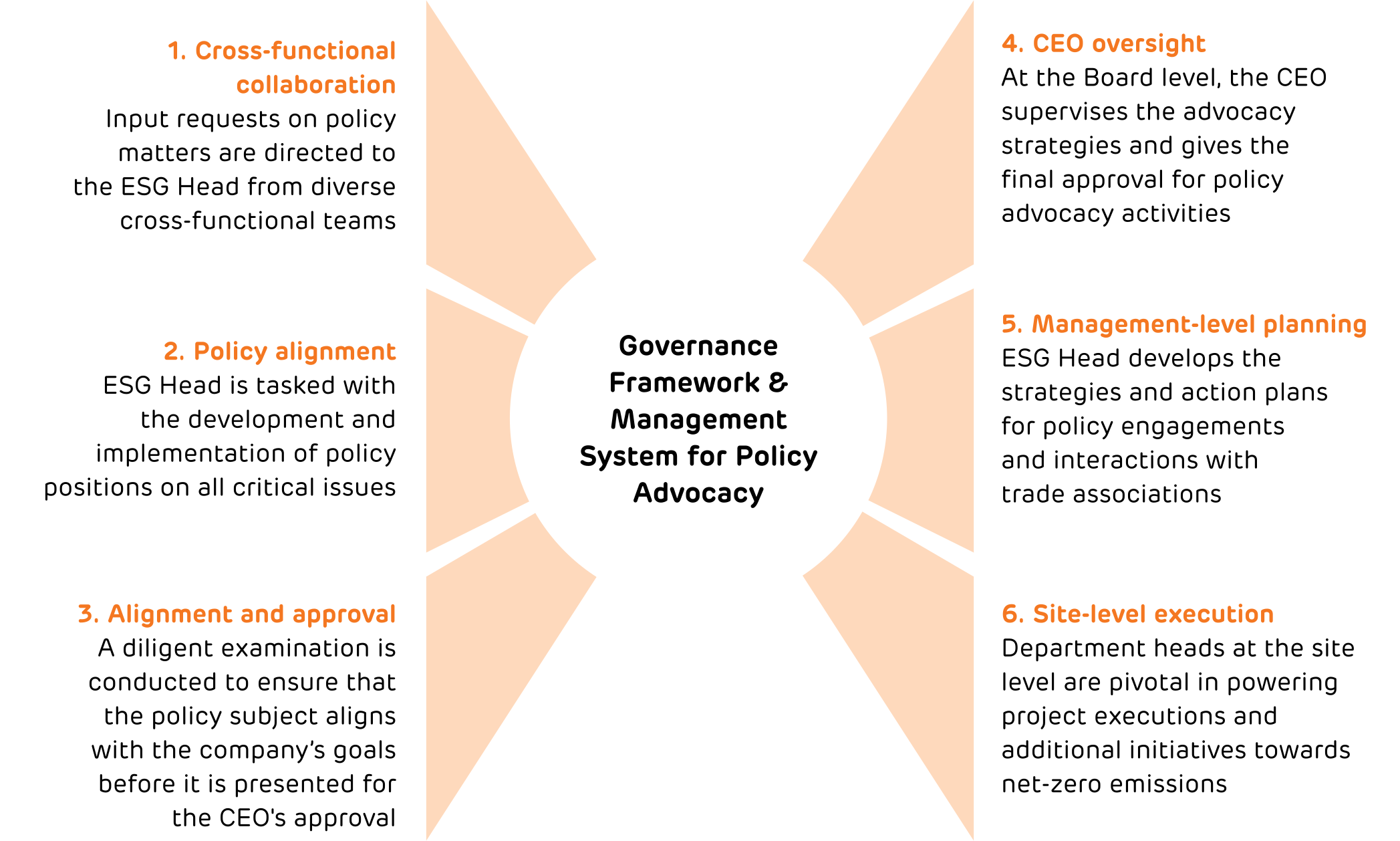
Review & Monitoring
Our policy advocacy efforts and initiatives are evaluated on a quarterly basis by the Corporate Responsibility Committee. Discrepancies between the advocacy work of the trade associations and our commitments, if any, are identified by the ESG Head, who takes necessary corrective measures to fill the gap.
Identification
Continuous monitoring of trade association activities and their position on the Paris Agreement.
Analysis
Evaluation of the degree of misalignment and its potential impact on APSEZ's climate commitments.
Public Statement
Clarification of the company's position, and distancing it from any misalignment with the Paris Agreement.
Engagement
Initiation of direct dialogues with trade associations to discuss concerns and emphasise the need for alignment with our climate goals; Partnering with trade associations to address any misalignments within a clear timeline, and considering disassociation from the trade associations if the efforts fail.
Policy Engagement on Climate Issues
We have strategically aligned our sustainability and decarbonisation initiatives with the objectives of the Paris Agreement and India’s Nationally Determined Contributions (NDCs). The overarching aim of this alignment is to exceed national climate targets ahead of prescribed timelines.
- APSEZ has partnered with the World Economic Forum (WEF) under its Transitioning Industrial Clusters initiative, supporting the Government of India’s climate agenda through the Adani Mundra Cluster, in collaboration with Adani Enterprises Limited (via Adani New Industries Ltd) and Ambuja Cements Ltd, with a shared goal of driving economic growth, job creation, and full decarbonisation by 2050
- APSEZ actively engaged with national industry and government stakeholders through the First Meeting of the CII National Committee on Shipping & Ports (FY 2025-26) held in Mumbai. Senior leadership participation in the forum enabled strategic dialogue on key policy priorities, including port modernisation and competitiveness, shipbuilding and MRO development, inland waterways and coastal shipping, green ports and sustainability-driven clearances, and maritime skilling. These deliberations align closely with APSEZ’s long-term vision for a globally competitive, environmentally responsible, and integrated port-led logistics ecosystem. They also reinforce the company’s commitment to supporting national initiatives, such as Sagarmala, Make in India, and India’s net-zero and maritime decarbonisation pathways, through collaborative policy engagement
- During India Maritime Week (IMW) 2025, organised by the Indian Ports Association under the Ministry of Ports, Shipping and Waterways, APSEZ contributed to national policy dialogue on Blue Economy, port-led development and sustainable maritime growth, while advocating Make-in-India innovation, indigenous port and dredging capabilities, AI-enabled logistics, and increased participation of women in the maritime sector, aligned with the Sagarmala Programme and Maritime Vision 2030
- Senior leadership from APSEZ participated in an exclusive global dialogue on climate action and sustainable markets at Windsor Castle, hosted by His Majesty King Charles III under the Sustainable Markets Initiative. Represented by its Whole-time Director & CEO, Ashwani Gupta, the engagement highlighted the growing role of private-sector leadership –particularly port operators – in advancing decarbonisation pathways for international shipping consistent with global climate objectives
- The discussions focussed on practical solutions such as green shipping corridors, shore power infrastructure, and alternative marine fuels, while also addressing enabling conditions including regulatory certainty, technology deployment, innovative financing, and risk-sharing frameworks. With a net-zero target of 2040 and a comprehensive sustainability roadmap, APSEZ positioned itself as a leading contributor to global efforts aimed at accelerating low-carbon transitions across the maritime and logistics ecosystem
APSEZ engages with a range of industry associations, chambers of commerce and global policy platforms to contribute to policy dialogue, industry’s development, and sustainable business practices.
Industry Associations
As an industry leader in promoting policy advocacy, we engage with prominent industry associations, including:

Confederation of Indian Industry (CII)
A leading proponent of policy advocacy and sustainable business practices.

The Associated Chambers of Commerce and Industry of India (ASSOCHAM)
Involved in shaping the narrative on sustainable growth in Indian industries.

Hazira Area Industries Association (HAIA)
Engaged in promoting responsible industrial activities in the Hazira region.

Federation of Indian Export Organisations (FIEO)
Focussed on addressing the impacts of climate policies on trade and exports.

Gujarat Chamber of Commerce and Industry (GCCI)
Encourages regional enterprises towards eco-friendly operations.

Southern Gujarat Chamber of Commerce & Industries (SGCCI)
Supports industries in Southern Gujarat to adopt green policies.

Federation of Indian Chamber of Commerce and Industry (FICCI)
Engaged in dialogues for business resilience and climate advocacy.

Federation of Kutch Industries (FKI)
Committed to sustainable industrial development in the Kutch region.

Industrial Waste Management Association, Chennai (IWMA)
Pioneers the safe and sustainable disposal of industrial waste.

Indian Maritime Centre (IMC)

Principles Subscription
We are proud to have subscribed to international principles as members/signatory to the following initiatives:

United Nations Global Compact (UNGC)
Upholds principles of human rights, environment and ethical business on a global scale.

India Business & Biodiversity Initiative (IBBI)
Aligns business operations with biodiversity conservation and ecosystem services.

IUCN - Leaders for Nature (LfN), India
Collaborates with conservation leaders to integrate biodiversity into business strategies.
Global Policy Platform
We have partnered with the following international policy platform as part of our efforts to contribute to global multi-stakeholder dialogue:

World Economic Forum (WEF)
Major collaborator on global agendas for economic development and environmental stewardship.
Our memberships and subscriptions enable us to reinforce our commitment to leading the transition towards a sustainable and low-carbon economy.