
Building resilience for growth

Risk and opportunities management are integral to our long-term resilience and value creation. Our risk management framework is designed to proactively identify and mitigate present and emerging risks, while systematically capturing opportunities. The integration of sustainability-related risks and opportunities, with their financial implications, further strengthens resilience and informs our strategy and capital allocation. These efforts make us agile, future-ready and well-positioned to deliver long-term growth.
Approach to Enterprise Risk Management (ERM)
We have a comprehensive ERM framework based on the globally-recognised Committee of Sponsoring Organisations (COSO) framework. It enables:
- Timely identification, prioritisation, management, monitoring, and reporting of key and emerging risks
- Effective management of financial and non-financial risks to achieve strategic objectives
- Seamless integration of internal controls into business processes
We have embedded ERM into our business planning and compliance functions. Additionally, risk criteria are integrated into service design, with financial incentives aligned to risk metrics. An effective risk culture is promoted through awareness and training programmes, including:
- Regular ERM training for non-executive directors
- Organisation-wide focussed training on risk management principles
- Function-specific risk training
- Multi-functional climate change and sustainability training by internal and external resources
Integrating Sustainability Aspects
We identify and mitigate risks and pursue emerging opportunities to safeguard stakeholder interests and promote sustainable business growth. We have integrated sustainability-related material risks and opportunities into our ERM framework, in alignment with IFRS S1 disclosure requirements, which supports such identification and assessment.
Risks such as climate change, biodiversity loss, and evolving regulatory landscapes are analysed through scenario analysis and materiality assessments, then incorporated into the corporate risk register. Each risk is evaluated for financial impact, probability of occurrence, and time horizon of materialisation, using both quantitative and qualitative measures. Corresponding action plans are implemented to address risks and capitalise on opportunities. These actions include operational controls, management of physical and transitional climate risks, adoption of renewable energy, electrification of port equipment, and biodiversity management initiatives. Strategic opportunities, such as green operations and circular economy projects, are embedded into overall business planning.
Integrating Sustainability Risks & Opportunities with Strategy
We have embedded sustainability risks and opportunities to inform strategic decision-making and support long-term value creation and organisational resilience.
Our Approach
Strategic Alignment
- Evaluating sustainability risks alongside financial and operational risks during strategy reviews
- Embedding sustainability opportunities like renewable energy adoption, zero-waste initiatives, and the electrification of equipment into growth plans
Scenario Analysis
- Assessing near- and long-term climate and transition risks to inform capital allocation and investment decisions
- Stress-testing strategic projects against sustainability risks across future scenarios
Internal Carbon Pricing
- Internal carbon price of USD 20/mtCO2e established for Scope 1 and Scope 2 emissions
- This guides investment by prioritising low-carbon technologies and mitigating the financial impacts of current and prospective GHG regulations
Supplier Assessment
- Screening suppliers on ESG performance to reduce value-chain risks and emissions
- Capacity building support to mitigate risk and unlock opportunities in sustainable supply chains
Resource Allocation
- Prioritising budgets towards projects addressing high-impact sustainability risks and opportunities aligned with strategic objectives
Governance & Oversight
- Board and RMC oversee the integration of ESG risks and opportunities into corporate strategy
- Cross-functional management teams ensure alignment of sustainability objectives with business goals
Key Performance Indicator Monitoring
- Dashboard to track performance on sustainability risks and opportunities, linked to executive scorecards and regularly reviewed
Risk Governance
We adopt a dual (bottom-up and top-down) approach to risk management with the framework structured across three lines of defence. The Board Risk Management Committee (RMC) and various sub-committees constituted under it oversee the framing, implementation and monitoring of the ERM process. The RMC provides Board-level oversight of APSEZ’s risk management framework and reviews the risk management plan to ensure its effectiveness. The Committee meets at least once every quarter to review risk exposure and mitigation plans on behalf of the Board. Our RMC is chaired by an independent director and comprises three members, all non-executive directors, including two independent directors, each bringing diverse business experience and extensive risk management exposure.
Dual Approach to ERM
Regular identification and assessment of risks by our ports, logistics, agri-logistics, service units and corporate functions, followed by effective mitigation.
Identification and evaluation of long-term, strategic and macro risks by the Risk Management Committee (RMC) and the Risk Management Group, comprising the Senior Leadership Team.
Three Lines of Defence
- Site Risk Managers: Prioritisation and approval of site-level operational risks by location heads and designated site risk managers, along with implementation of mitigation plans
- Department Risk Representatives: HODs identify and log critical risks, implement mitigations and support ongoing lead-indicator assessments
- Chief Risk Officer sets control standards, oversees compliance and reports directly to the CEO, ensuring adherence to risk management standards
- Management Audit & Assurance Services (MA&AS) team:
- Expert accountants, engineers, and SAP executives monitor and audit risk management performance across functions
- Provide objective assurance of risk management and compliance processes, reporting directly to the Chairman of the Board
- Conducts annual systematic internal audits, performed by qualified internal auditors, to ensure the effectiveness of the ERM framework
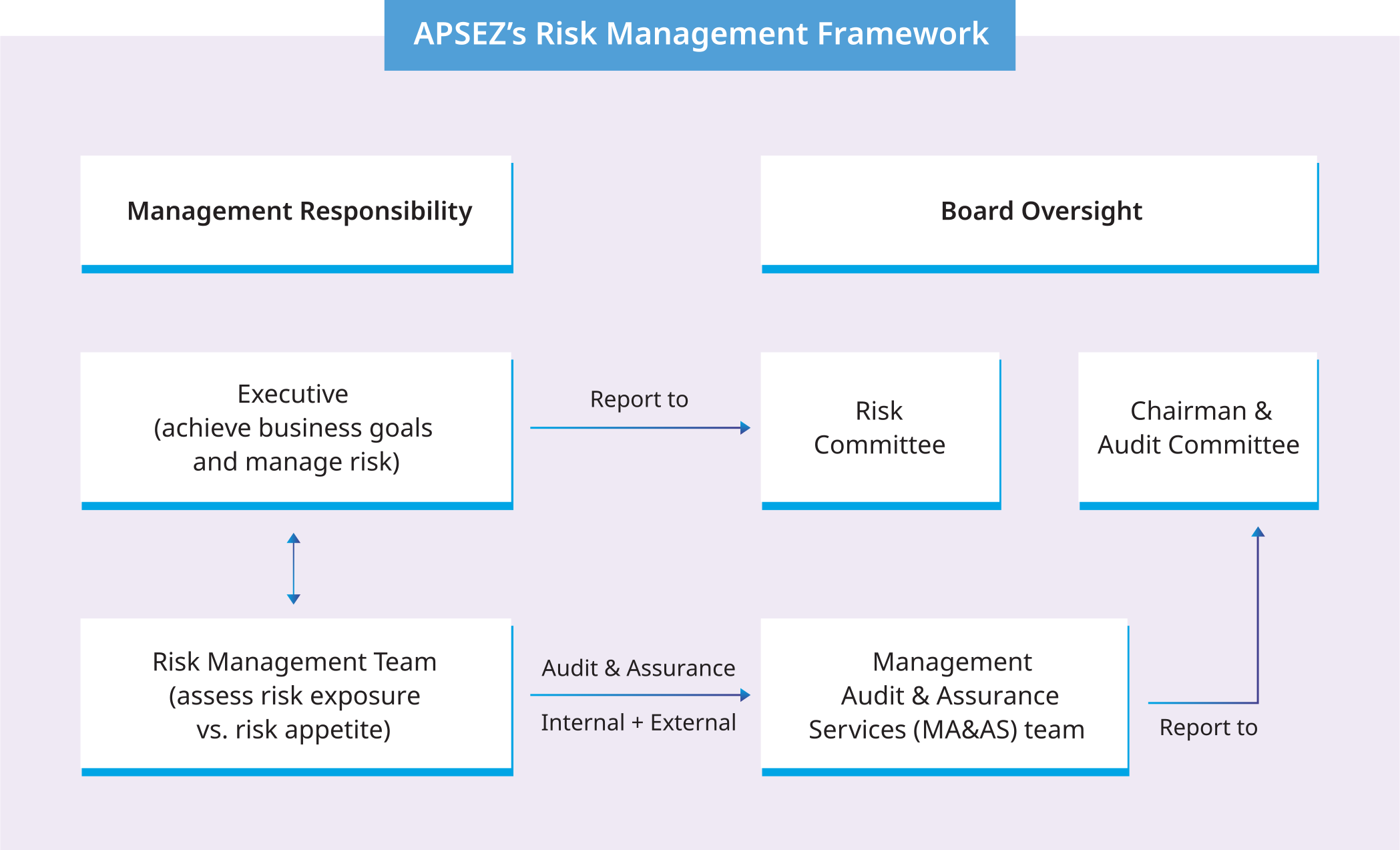
Functions Performed by the Executive Management and / or RMC
- Review and approve risks and opportunities associated with business proposals
- Guidance on supervision, assessment and management of risks
- Develop risk assessment and measurement systems
- Establish policies, practices and other control mechanisms to contain risks, including reviewing and monitoring their effectiveness
- Review and identify cybersecurity risks and their management
Actions by the Risk Function in FY 2025-26
- RMC conducted 4 meetings
- Ensured integration of material risks in Risk Management Policy approved by the Board
- Established a policy framework to strengthen risk profile, with a focus on prudent project practices across conceptualisation, implementation and sustenance along with appropriate risk mitigation
- Efforts to minimise the adverse impact of risks on key business objectives and leverage emerging opportunities
- Operated a robust risk assessment model incorporating quantitative and qualitative data
Risk Management Process
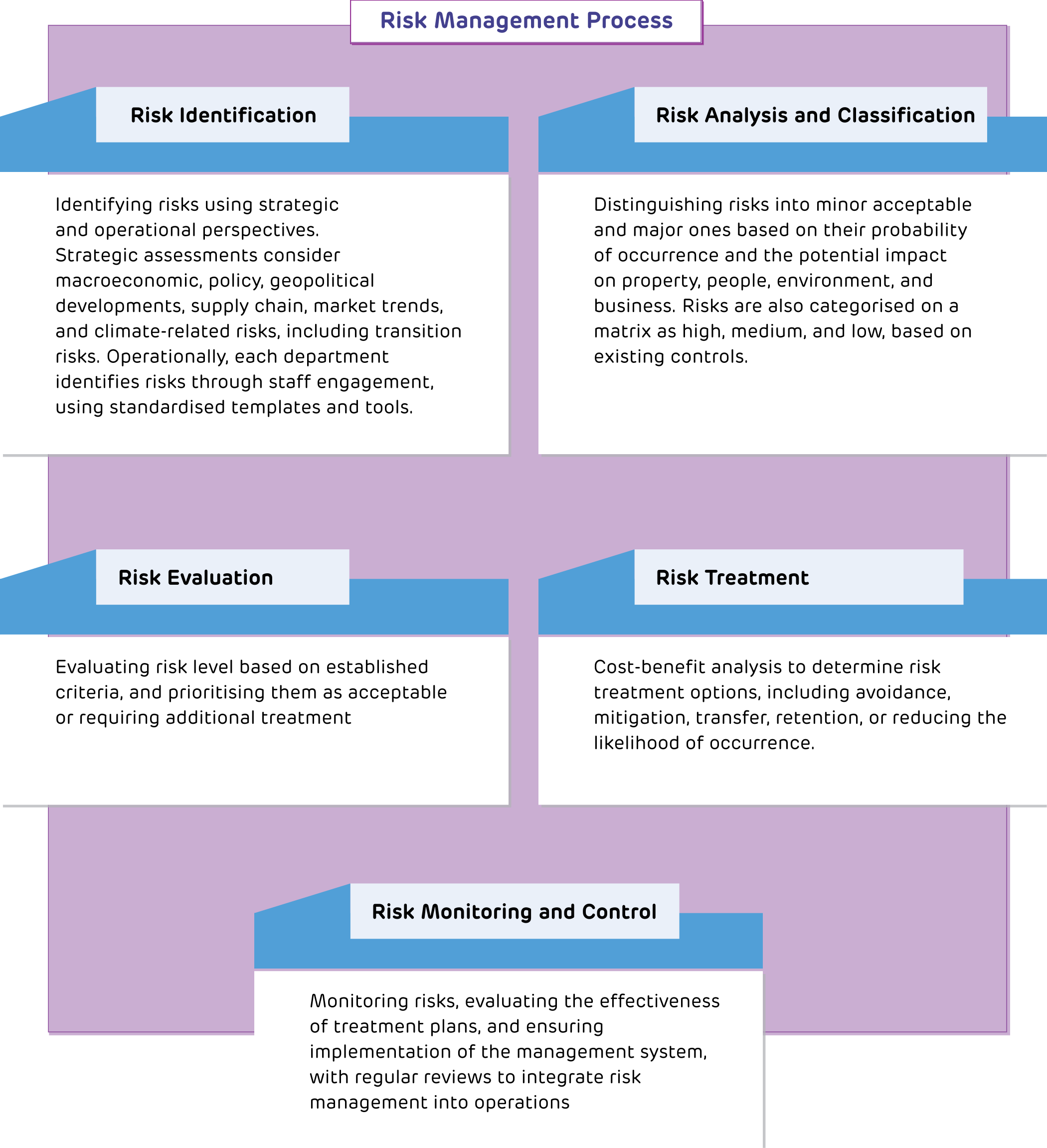
Risk Exposure Review
We proactively identified and addressed risks during FY 2025-26 through preventive measures and mitigation plans. Our risk management team established risk appetites, defining acceptable risk levels for achieving our goals, which were approved by the RMC. They also compared actual risk exposure with acceptable levels every quarter, reporting any gaps to both the management and the RMC.
Our Top Risks
| R1 Political Risk |
R2 Regulatory Risk |
R3 Competition Risk |
R4 Financial Risk |
SR1 Climate Risk (Physical & Transition) |
|
|---|---|---|---|---|---|
| Category | External | External | External | Operational | External |
| Likelihood of occurrence | Regular elections and leadership changes | Exposure to regulations of multiple jurisdictions | Less competitive intensity in key markets | Strong cash flows and a stable credit rating from global rating agencies | Exposure to extreme weather events, evolving regulations/customer preferences and low business viability |
| Magnitude of potential impact | Policy continuity across successive governments | Diversification limits impact | Scale and integrated operations limit competitive pressure | Accelerated expansion may cause financial disruption | Potential damage to capital-intensive assets and high investments needed in transitioning to a low-carbon economy |
| Risk priority | |||||
| Responsibility | Site CEO’s Office, CEO’s Office, Corporate Affairs | Regulatory Compliance Team | Site CEO’s Office, Business Team | Head, Finance | ESG team, CEO APSEZ |
Risk Appetite
We determine risk appetite by evaluating exposure to risks, potential outcomes, business objectives, and industry standards, and defining clear quantitative and qualitative risk levels aligned with strategic goals. Our risk appetite is decided by the risk management team and approved by the RMC, with a quarterly assessment of the actual risk exposure against acceptable levels and escalation of any gaps to the management and RMC.
Mitigating Enterprise Risks
Material Topics
Capitals Deployed
 Financial Capital
 Manufactured Capital
 Intellectual Capital
 Human Capital
 Social and Relationship Capital
 Natural Capital
Strategic Priorities
Risk Description
Political instability or a change of government could trigger a reassessment of existing policies or regulatory approvals
Impact on Value
- Decline in sectoral opportunities and thus limited growth prospects
- Potential reduction in investment viability or profitability
Mitigating Measure
- We operate across multiple Indian states, maintaining a neutral stance with different regional political parties and avoiding affiliation or contribution to any party
- Cooperation and engagement with all regulatory authorities to ensure full compliance and align with policy objectives
Associated Opportunities
Our political neutrality and constructive engagements enhance regulatory predictability, support timely approvals and ensure shaping policies that are beneficial to industry growth.
Risk Description
Any unfavourable developments in national or overseas regulations, including tariff barriers, could negatively impact trade flows.
Impact on Value
Operational slowdown, pressure on credit ratings and reduced profitability from elevated compliance costs.
Mitigating Measure
- All our existing and expansion projects have the necessary regulatory, environmental and social approvals
- Our business and expansion strategies are aligned with national priorities
- Our diversification across cargo, geographies, multimodal logistics and customers reduces exposure to regulatory changes
- Board-level oversight of regulatory and compliance matters, with a dedicated team to track changes
Associated Opportunities
Exposure to diverse regulatory regimes positions us to deepen engagement with authorities and strengthen compliance practices. This creates opportunities to align with policy shifts, capture market expansion opportunities and tap new business prospects.
Risk Description
Growing competition from the development of new ports, logistics parks and multimodal infrastructure.
Impact on Value
Pressure on business volumes, pricing, and market share.
Mitigating Measure
- We are differentiated as an integrated transport utility offering end-to-end logistics solutions
- Strong customer value proposition driven by operational excellence, delivery of efficient, cost-effective services through a digitised value chain and global best ESG practices
- Strategic partnerships with shipping lines ensure sticky cargo
- Operationalised AI-powered Strategic Command Center for seamless logistics operations management
- Committed large-scale investments in expanding port and multimodal logistics capacities, upgrading technology and delivering value-added services to tap market opportunities
Associated Opportunities
Our focussed investments create opportunities for volume growth, deeper customer integration, and increased value capture through scale and integration.
Risk Description
Risks to financial health due to deterioration in credit quality, liquidity constraints, operational disruptions and failure to adapt to climate change regulations and enhanced disclosure standards.
Impact on Value
Higher borrowing costs and restricted capital access, adversely affecting profitability, long-term growth and investor confidence.
Mitigating Measure
- We ensure prudent capital and debt management, with strong audit and control systems, ensuring compliance with debt covenants
- Investment grade rated with net debt to EBITDA of 1.9x and average debt maturity of 5.4 years and funds from operations of ₹19,193 crore
- Healthy net cash flow generations, averaging ₹20,358 crore in the last year, provide adequate headroom to fund working capital and capex
- Maintained top credit ratings from global ratings agencies
Associated Opportunities
Our financial discipline, with resilient cash flows, ensures steady access to capital to pursue our ambitious expansion plan across market cycles while maintaining balance sheet health and investor confidence.
Risk Description
Our operations face physical and transition risks emanating from climate change.
Impact on Value
Decline in cash flows and long-term value creation due to:
- Increased operational and compliance costs
- Capex incurred due to asset damage and deployment of transition technologies
- Underutilisation of assets due to climate events or transition
Mitigating Measure
- Progressing roadmap toward net-zero by 2040, with planned investment of ₹6,000-8,000 crore in decarbonisation initiatives
- Optimised electricity/energy costs, increased share of renewable energy to 28% and acquired 660+ eITVs
- Conducted climate risk assessment to identify physical and transition risks and their potential impact
Associated Opportunities
Investments in sustainable practices/technologies create opportunities to improve operational efficiency and resilience, access finance tied to climate change, strengthen stakeholder trust and enhance our competitiveness.
Risk Description
A slowdown in the economy, trade or logistics sector can impact cargo demand and logistics volumes.
Impact on Value
Lower port and logistics asset utilisation, leading to revenue unpredictability and pressure on profitability.
Mitigating Measure
- We have diversified operations across geographies, commodities and multiple businesses, reducing dependency risks; logistics and marine business are witnessing an exponential growth trajectory
- Strategic expansion of multi-modal logistics, strengthening seamless supply chain ecosystem
- Strengthened cargo capabilities in growth areas:
- Expanded container capacity across our terminals along the Indian coastline
- Augmented LNG and LPG capabilities to support India’s gas-based transition
- Invested in coastal coal-focussed ports, essential to support India’s growing power demand
- Invested in tank farms to capture evolution in liquid bulk supply chains
- Aggressively expanded international operations, including scaling freight services, expanding the marine fleet into West African waters to strengthen MEASA region presence and port operations
Associated Opportunities
Our integrated operations and strategically located assets reduce logistics costs and ensure faster delivery, deepening our customer proposition and enabling us to capture greater value.
Further, our diversification across high-growth, government-priority infrastructure segments will enable demand stability and sustained volume growth across cyclicality.
Risk Description
Growing operational digitisation and integration of modern technologies heighten risks of system failures, cyber threats, data privacy and data breaches.
Impact on Value
Operational disruptions, financial losses, and erosion of stakeholder confidence.
Mitigating Measure
- We have strengthened cybersecurity through continued investments in modernising technology infrastructure and establishing the Information Security Management System (ISO 27001), along with a dedicated Information Technology & Data Security Committee
- Investments in advanced analytics and artificial intelligence
- Enhanced resilience through regular cybersecurity monitoring and awareness penetration testing programs, incident response protocols and business continuity plans
Associated Opportunities
The use of advanced technology improves cyber risk prediction and mitigation, alongside operational efficiency and decision-making, creating a competitive advantage.
Risk Description
Delays in expansion projects can cause cost overruns and impact their long-term viability.
Impact on Value
Deferred cash flows, lower project returns and higher payback tenure have an impact on growth visibility and capital efficiency.
Mitigating Measure
- We have over two decades of expertise in project management and execution, enabling rigorous planning of resources, land acquisition, construction-readiness and supply chain management with milestone-based monitoring
- Demonstrated track record of timely and cost-effective project commissioning, with strong ESG, safety, and quality controls
- Timely commissioning of Dhamra and Karaikal port expansion; other port and logistics park expansion projects progressing as planned
Associated Opportunities
Our sharp focus on enhancing project management and governance practices positions us to enhance returns on investment and expedite revenue realisation.
Risk Description
Concerns among the fishing community about environmental and social impacts in the port hinterland could lead to opposition or disruptions.
Impact on Value
Operational delays, reputational damage, and potential loss of licence to operate.
Mitigating Measure
- We undertake structured community engagement programs complemented by a grievance redressal mechanism to address concerns transparently and promptly
- Investment in community development programs aligned with local priorities to build stronger relationships
- Ensuring sustainable and responsible operations through environmental assessments and collaborating with local authorities to exceed compliance requirements
Associated Opportunities
Proactive community engagement and effective management of their concerns enhance our trust and reputation, strengthening our social licence to operate. This also ensures long-term asset sustainability and supports smoother, timely execution of growth projects.
Risk Description
Concentration in select geographies poses risks of adverse developments in the regional market, including regulatory changes, shifting weather patterns, low demand or supply chain constraints.
Impact on Value
Operational disruptions, decline in cargo flows and volatility in revenue, margins and return on capital.
Mitigating Measure
- We have strategically diversified our presence across port and logistics assets spanning multiple domestic and international markets
- We periodically assess geographic and climate-related risks of key assets
- Ensuring balanced allocation of capital across regions and cargo types
Associated Opportunities
Geographical diversification strengthens business resilience and enables capturing market share across multiple markets, driving long-term growth.
Risk Description
Inability to identify and acquire suitable land parcels (by size, location, topology, and cost) could delay expansion.
Impact on Value
Time and cost overruns in projects, reduced growth potential, and loss of competitive advantage.
Mitigating Measure
- Our centralised land management team ensures the timely acquisition of strategic land parcels
- We deploy robust land management practices:
- Digitisation of land records and real-time property monitoring dashboards for informed decision-making
- Developing multi-use facilities and undertaking innovative measures to optimise land use
- Early-stage land acquisition aligned with long-term capacity expansion plans
Associated Opportunities
Strategic land acquisition and management practices enable the development of multi-use facilities, optimising land utilisation, improving operational efficiency, and supporting scalable growth.
Risk Description
Failure to uphold human rights standards across our operations, the value chain, workforce and community could result in legal action and penalties.
Impact on Value
Financial losses due to penalties and operational disruption, adverse impact on credit/ESG rating and reputation and reduced access to capital.
Mitigating Measure
- We have comprehensive human rights policies with zero tolerance for any violations
- We undertake periodic risk assessments covering the entire value chain
- Robust grievance redressal mechanisms in place for employees, communities, and other stakeholders
Associated Opportunities
Strong commitment to upholding human rights practices improves stakeholder trust, improves credit/ESG rating and supports workforce engagement and retention.
Risk Description
Rapid expansion and large-scale investments to fund infrastructure projects pose the risk of servicing long-term debt obligations.
Impact on Value
Adverse impact on credit profile and the ability to finance/refinance projects at low costs.
Mitigating Measure
- Our cash and cash equivalents of ₹12,193 crore, translating into 22% of gross debt
- Bought back USD 386.03 million bonds and issued ₹5,000 crore NCDs for 15 years, improving average debt maturity to 5.4 years
- Our operations generate healthy and recurring cash flows, adequate to fund a majority of annual capex needs
- Improved net debt to EBITDA at 1.9x in FY 2025-26
- APSEZ is investment-grade rated, the highest within India’s ports sector
Associated Opportunities
Our continued focus on strengthening cash flows and liquidity will support:
- Timely debt servicing, credit rating improvement and availing lower-cost financing
- Prepayment of high-cost debt and improve profitability
- Internal funding of capex
Risk Description
Risks of returns on investments falling short of expectations due to execution delays, cost overruns and rising inputs and debt costs.
Impact on Value
Decline in capital efficiency and shareholders’ returns due to higher debt and execution costs.
Mitigating Measure
- Rigorous project appraisal and disciplined execution ensure adherence to project timelines, improving returns profile
- Completed land acquisition and advanced ordering for equipments
- Ongoing measures for cost optimisation to protect project economics
Associated Opportunities
Our efforts to ensure effective execution and capital discipline will help improve ROCE and enable faster scaling of value-accretive projects.
Risk Description
Rising capex and market volatility can strain our balance sheet and liquidity.
Impact on Value
Reduced liquidity can increase funding costs and put constraints on expansion plans, affecting returns and credit profile.
Mitigating Measure
- Adequate liquidity buffers and robust-free cash flows to fund growth while ensuring balance sheet integrity
- Proactive liquidity and cash flow management to support business objectives and optimise yields
Associated Opportunities
Focus on liquidity management enables flexible capital deployment and timely execution of expansion plans to capitalise on growth opportunities.
Risk Description
Inadequate internal controls could lead to errors, negligence, misstatement or misuse of funds.
Impact on Value
Financial losses, operational disruption and loss of stakeholder trust.
Mitigating Measure
- Our robust internal control system ensures accurate, complete, and reliable financial reporting
- Defined systems, standards, and processes to govern our daily operations, with a robust code of conduct that guides acceptable behaviour and practices
- ESG control processes reviewed by Management Audit & Assurance Services (MA&AS)
Associated Opportunities
Stronger controls enhance operational and financial efficiency, strengthen ethical standards and reputation and support effective ESG management. This builds a foundation for long-term value creation.
Integrating Climate Aspects
Climate-related risks pose significant vulnerability to operations and their mitigation has become extremely crucial in the present business landscape. Climate-related risks include:
- Physical risks: Rising sea levels and extreme weather events (storms, flooding, droughts and severe winds)
- Transition risks: Technological, regulatory and market changes for a lower-carbon economy
We employ a thorough climate risk assessment to identify and assess physical (acute and chronic) and transition (regulatory, technological, legal, market, reputational) risks covering our own, upstream and downstream operations over short, medium and long term. We have conducted climate scenario analysis across all our ports and terminals, including international operations, to assess climate-related financial and business risks.
Sensitivity Analysis
Climate change has increased the frequency and intensity of extreme weather events and the risk of operational disruption is expected to rise. We have conducted a sensitivity analysis covering all 19 ports. The methodology involved changing financial and operational driver metrics while holding other parameters constant. The analysis evaluated that a one-day closure of Mundra, our largest port, and that of all ports combined could result in a loss before tax of about ₹23 crore and ₹83 crore respectively.
Accordingly, we conducted a climate vulnerability and risk exposure assessment for 17 ports using 1.5°C and over 2.0°C scenarios aligned with IPCC AR6. Based on the findings, detailed adaptation plans have been developed for the ports that are at most risk.
Sensitivity to Financial Risks
| Driver | Change | Impact on | Amount (in ₹ crore) |
|---|---|---|---|
| Climate risk like disruption of port operation from cyclone, extreme heatwave, etc. at: | |||
| Mundra Port (our largest port) | 1 day | Profit before tax (PBT)* | (23) |
| All ports | 1 day | Profit before tax (PBT)* | (83) |
| Interest rate | +/- 50 bps | Profit after tax (PAT) | -/+ 77 |
| Foreign currency risk — INR / USD | +/- 1% | PAT | -/+ 120 |
| INR / EUR | +/- 1% | PAT | -/+ 2 |
| INR / CNY | +/- 1% | PAT | -/+ 1 |
| INR / JPY | +/- 1% | PAT | -/+ 0.06 |
* Before exceptional items
Emerging Risks
The global business landscape is rapidly evolving, driven by economic, social, environmental, legal, and technological changes. This exposes us to emerging risks that may not be fully captured in existing risk assessments. While such risks currently have low to medium likelihood of occurrence and impact, they can potentially become material in the medium to long term unless proactively managed.
Two key emerging risks that our business faces are technological changes for ports and changing geoeconomics. We are continually monitoring them, evaluating their potential implications and implementing mitigation measures to minimise residual risks such that they remain within our approved risk appetite threshold.
Skill gaps in the workforce to adapt to technological advancements/automation
Advancements in automation, digitalisation and AI can disrupt existing operating models.
Failure to adopt new technologies at scale supported by technologically adept manpower may impact competitiveness, operational efficiency and a shortfall in meeting customer expectations.
- Inability to support large-scale integrated and automated port and logistics operations
- Risk of losing competitive advantage driven by low-cost labour, operational inefficiencies and missed growth opportunities due to slower adoption of advanced technologies
- Potential growth, productivity and profitability gains falling short of expectations due to data limitations that hinder system integration and the high capital investment required
- Established digital roadmap with ongoing investment in digital platforms, automation, and advanced analytics
- Piloting automation and emerging technology projects, followed by scaled deployment
- Capability building to strengthen internal processes and the team’s execution-readiness
Disruption of interstate relations leading to a shift in cargo demand/customer base
Shifting world order and global trade patterns could impact cargo demand and trade flows.
Key drivers include:
- Rising geopolitical tensions and implementation of protectionist policies
- Trade controls, sanctions and non-tariff barriers arising from extraordinary situations like wars, geopolitical tensions and COVID-19 like situations
- Focus on near-, friend- or on-shoring of manufacturing by the developed economies
- Transition to a low-carbon economy and implementation of a carbon border tax, such as that proposed by the European Union
The surge in such events recently has disrupted trade flow, driving volatility in the supply chain and trade of energy-related commodities.
- Decline in transhipment trade volume due to the rerouting of supply chains and erratic demand and in movement of emission-intensive cargoes from emerging economies like India
- Lower port utilisation, revenue predictability and margin pressure from increased costs or demand volatility
- Heightened uncertainty affecting long-term growth visibility
- Continued focus on diversifying cargo mix and geographic footprint to reduce reliance on any single cargo type, market or trade corridor
- Established ambitious ESG goals, with a focus on net zero emissions to align with the stringent ESG regulations of developed nations
- Proactive engagement with customers and authorities to anticipate policy and trade developments