
Leading the Future of Integrated Logistics
Our evolution into a diversified integrated global transport platform is driven by the strength of our three core verticals: Ports, Logistics, and Marine.
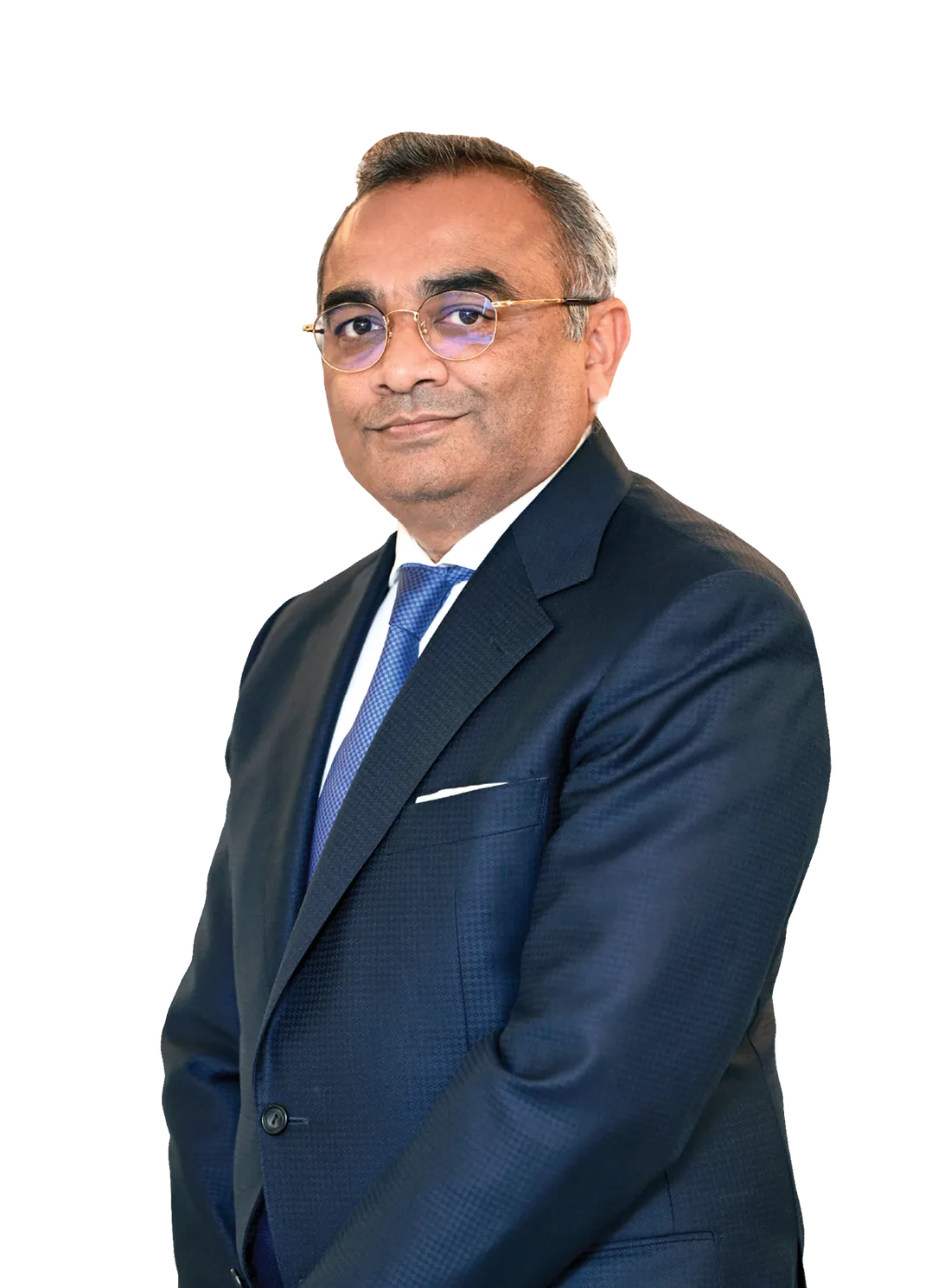
ASHWANI GUPTA
Dear Stakeholders,
FY 2025-26 marks a defining chapter in the evolution of Adani Ports and Special Economic Zone Ltd. (APSEZ). It is a year that reaffirmed not only the resilience of our portfolio, but also the clarity of our strategy and the strength of our execution – amid an environment shaped by global uncertainty, shifting trade patterns, and rapid technological change.
Our evolution into a diversified integrated global transport platform is driven by the strength of our three core verticals: Ports, Logistics, and Marine. By applying disciplined capital allocation and deep operational focus across these segments, we transformed global complexities into momentum, delivering a 25% increase in revenue and a 20% increase in EBITDA. In our Ports vertical, domestic flagship facilities achieved record cargo volumes alongside landmark developments such as the nation-first VLCC terminal at Mundra, the groundbreaking of Vizhinjam Phase II expansion and the inauguration of Haldia’s automated dry bulk terminal. Internationally, our expansion accelerated via the NQXT acquisition in Australia, our strategic IMEC partnership with the Port of Marseille Fos, and the rapid ramp-up of Colombo West International Terminal (CWIT), which handled over 1 million TEUs in its first year.
Complementing our robust port infrastructure, our other two verticals delivered pivotal operational milestones. In the Logistics segment, we demonstrated exceptional execution by commissioning three Inland Container Depots (ICDs) within a single fiscal year and successfully completing our first containerised grain rake movement. Through focussed asset optimisation, we strengthened operational efficiency and capacity readiness.
Concurrently, our Marine vertical significantly advanced industry safety and self-reliance. We operationalized India’s first formal Port of Refuge (PoR) system, establishing dedicated safe havens for ships in distress at Dighi and Gopalpur Ports and renewed critical emergency towing vessel contracts. Notably, the Marine division maintained all ports with zero external dependency, leveraging an expanding in-house fleet of dredgers to cross a record 60 million cubic metres of dredging. Validated by prestigious industry awards for safety and sustainability, the combined success of these three verticals reaffirms our commitment to building a resilient, future-ready transport platform.
Scalable Global Integrated Infrastructure Platform
As India’s largest and one of the world’s fastest growing integrated transport platforms, APSEZ is powered by a distinct and durable value proposition. Our investment thesis rests on four mutually reinforcing pillars that provide visibility, resilience, and long-term compounding.
Scale and Integration is the foundation of our leadership. Across 15 multi-commodity domestic ports, supported by a logistics network that reaches 95% of India’s hinterland, we have built a fully integrated ‘shore to door’ platform. Our fleet of marine vessels, 132 rakes, 25,000+ trucks in our trucking platform allow us to control critical links in the value chain, delivering reliability, efficiency, and speed to our customers while capturing greater value per tonne of cargo handled.
Capability and Capacity define how we convert scale into performance. Technology-led revenue enhancement, rigorous cost optimisation, and a lean, structured organisation underpin our execution. Strategic partnerships with leading Indian and global players, combined with best-in-class project delivery capabilities and an investment grade balance sheet, ensure both the capacity and capital access to pursue growth opportunities proactively.
India’s structural growth momentum continues to act as a powerful tailwind for our business. Global supply chain diversification under the China+1 strategy, recently concluded FTAs, and the emergence of corridors such as the India–Middle East–Europe Corridor (IMEC) are reshaping cargo flows in India’s favour. Sustained investment in national infrastructure corridors and logistics parks is improving connectivity and port competitiveness. Simultaneously, APSEZ is central to India’s energy security, spanning conventional fuels and the emerging energy transition. In parallel, the modernisation of agri-logistics and cold-chain infrastructure is driving additional cargo from rural production centres to urban consumption hubs.
Profitable growth is the natural outcome of our integrated platform, disciplined execution, and favourable structural tailwinds. Our India ports business continues to deliver industry-leading economics, with EBITDA margins of approximately 73.2%, underscoring the operating leverage and resilience embedded in our network. This strong foundation supports an accelerated financial trajectory, with revenues projected to grow at 19% CAGR between FY 2026-31. Consistent focus on enhancing ROCE by 1% annually, while embedding sustainability into every investment decision, reinforces our ability to compound returns and deliver superior long-term value creation. We became an early adopter of the TNFD framework, deepening transparency around nature-related risks, while advancing automation and digitalisation across ports, logistics and marine services.
Our India ports business continues to deliver industry-leading economics, with EBITDA margins of approximately 73.2%, underscoring the operating leverage and resilience embedded in our network.
Digital Transformation: Building Intelligence into Scale
While scale reflects the strength of our assets, our foundational digital transformation defines how we operate them. By embedding advanced technologies across our network, we are systematically re-engineering cargo flow to deliver unprecedented speed and efficiency. Automation is central to our ports, where AI-based NAVIS systems have unlocked additional capacity from existing assets, safeguarding our industry-leading margins. Our AI-driven Logistics Strategic Command Centre serves as our supply chain’s nerve centre, significantly improving turnaround times. Furthermore, integration of the cloud-based SeaFlux marine platform was crucial in delivering a robust 97% availability of vessels and supporting operational excellence across Ocean Sparkle’s fleet. Together, these initiatives are creating an intelligent, agile logistics network designed to drive sustainable growth and maximise efficiency across our entire organisational framework.
An Organisation Designed for Speed and Ownership
Supporting this transformation is a fundamental shift in how we organise ourselves. We have adopted a simplified three-layer organisational structure that flattens hierarchies and moves decision-making closer to where value is created – at ports, yards, vessels, and logistics nodes. By empowering frontline teams with greater ownership, accountability, and judgement, we are building a low friction organisation defined by speed and agility rather than centralised control. As we scale towards handling one billion tonnes of cargo, this structure ensures we grow exponentially without losing responsiveness, customer trust, or execution excellence.
Leading the Future of Integrated Logistics
As we look ahead, we do so with conviction. Our strategy is clear: to lead the next phase of transformation in global ports and logistics through automation, artificial intelligence, and electrification. While we remain attentive to geopolitical and trade dynamics, our focus remains firmly on shaping our own destiny.
Strong cash flows and financial discipline continue to underpin our growth ambitions, enabling decisive investment in capacity, technology, and sustainability. Our commitment to ESG is unwavering as we work towards building a decarbonised, resource-efficient logistics ecosystem. Sustainability, technology and integration remain central to our strategy. As India’s trade, manufacturing and energy needs continue to expand, we remain focussed on building future-ready infrastructure, enhancing multimodal connectivity, and creating long-term value for all stakeholders through disciplined growth and responsible operations.
Building on this momentum, we are introducing our 2031 long-term targets, that underscores our confidence in the scale, durability, and profitability of our growth strategy. By 2031, we aspire to more than double our revenue and EBITDA to exceed ₹ 90,000 crore and ₹ 50,000 crore, respectively. These targets are underpinned by structural demand drivers, expanded platforms, operational efficiencies, and a continued focus on margin enhancement and value creation for all stakeholders.
By 2031, we aspire to more than double our revenue and EBITDA to exceed ₹90,000 crore and ₹50,000 crore, respectively. These targets are underpinned by structural demand drivers, expanded platforms, operational efficiencies, and a continued focus on margin enhancement and value creation for all stakeholders.
I thank all our stakeholders for their trust and partnership. We are not merely participants in the global ports and logistics industry – we are helping shape its future. With clarity of strategy and confidence in execution, we remain committed to creating enduring value and building a resilient, intelligent, and sustainable enterprise for generations to come.
Ashwani Gupta
Whole-time Director & CEO, APSEZ